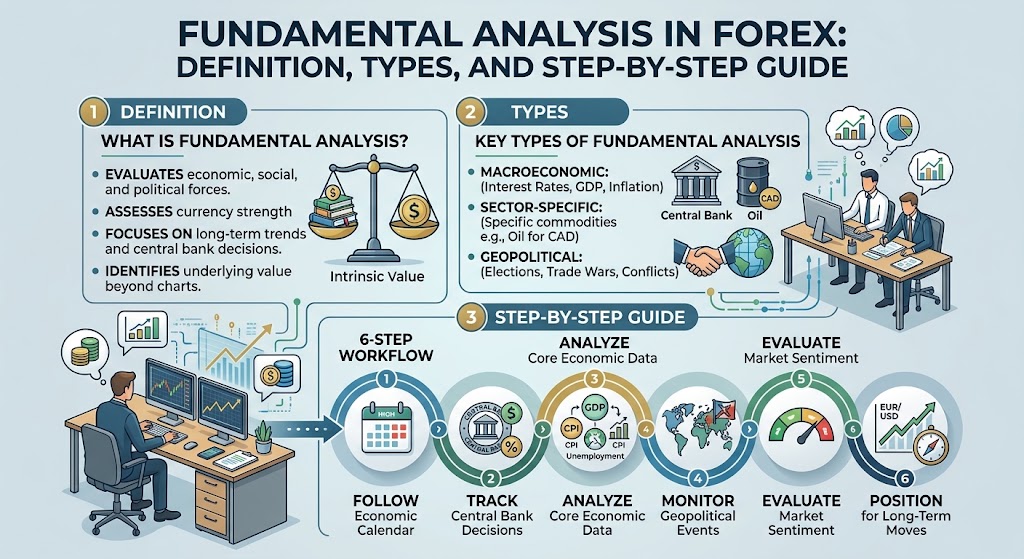
In foreign exchange (Forex) trading, long-term success relies heavily on understanding market drivers. While technical analysis focuses on price charts and patterns, Fundamental Analysis uncovers the underlying economic forces that move currency values.
This guide breaks down Fundamental Analysis in Forex, its key types, and how to apply it step-by-step in your trading strategy.
What is Fundamental Analysis in Forex?
Fundamental Analysis is the method of evaluating a country’s economic, social, and political conditions to determine the intrinsic value and future direction of its currency.
In the Forex market, currencies are traded in pairs (such as EUR/USD, GBP/USD, or XAU/USD). Each currency reflects the health of its issuing economy:
- Strong Economy: Attracts foreign investment, increasing demand for the currency (Bullish).
- Weak Economy: Discourages investment, reducing demand for the currency (Bearish).
Key Difference: Technical analysis answers when to enter or exit a trade, while fundamental analysis explains why the market is moving in a specific direction.
Types of Fundamental Analysis
When mastering Fundamental Analysis in Forex, traders categorize market drivers into three main dimensions:
1. Macroeconomic Analysis
This is the primary focus for Forex traders. It evaluates top-level economic data from major nations, including Interest Rates, Gross Domestic Product (GDP), Consumer Price Index (CPI), and Central Bank monetary policies.
2. Sector / Commodity Analysis
While microeconomic analysis evaluates individual corporate financial statements in stock trading, Forex traders monitor specific industries and correlated commodities. For instance, crude oil prices strongly influence the Canadian Dollar (CAD), while gold impacts the Australian Dollar (AUD).
3. Geopolitical and Market Sentiment Analysis
This evaluates how global events—such as elections, trade disputes, military conflicts, and natural disasters—shape market psychological sentiment and trigger risk-on or risk-off capital flows.
How to Conduct Fundamental Analysis in Forex (Step-by-Step)
Follow this structured workflow to integrate fundamental analysis into your daily trading process:
Step 1: Monitor the Economic Calendar
Before opening any trades, check platforms like Forex Factory, Investing.com, or Myfxbook. Focus on High Impact (Red Folder) news events scheduled for the day.
Step 2: Analyze Core Economic Indicators
Track these critical economic metrics to gauge currency strength:
| Economic Indicator | What It Measures | Impact on Currency |
| Interest Rates | Monetary policy set by central banks. | Higher rates attract foreign capital $\rightarrow$ Bullish. |
| Inflation (CPI) | Consumer Price Index tracking price rises. | High inflation leads to rate hikes $\rightarrow$ Bullish. |
| Employment Data (NFP) | Job creation and unemployment rate. | Strong employment signals economic health $\rightarrow$ Bullish. |
| GDP Growth | Total value of goods and services produced. | High growth boosts investor confidence $\rightarrow$ Bullish. |
| Retail Sales / PMI | Consumer spending and manufacturing activity. | Higher figures indicate economic expansion $\rightarrow$ Bullish. |
Step 3: Track Central Bank Policy and Stance
Pay close attention to statements and rate decisions from central banks like the Federal Reserve (Fed), European Central Bank (ECB), and Bank of England (BoE).
- Hawkish Stance: The central bank favors raising interest rates to curb inflation (Currency strengthens).
- Dovish Stance: The central bank favors cutting rates or easing policy to stimulate growth (Currency weakens).
Step 4: Evaluate Geopolitical and Safe-Haven Dynamics
During political uncertainty or global crisis, capital flows out of riskier assets into safe-haven assets like the US Dollar (USD), Swiss Franc (CHF), Japanese Yen (JPY), and Spot Gold (XAU/USD).
Key Benefits of Fundamental Analysis
- Identifies Long-Term Trends: Performing Fundamental Analysis in Forex helps institutional investors position capital for major market trends.
- Filters False Breakouts: Technical patterns can fail during high-volatility events; fundamental context helps verify whether a breakout has real momentum behind it.
- Improves Risk Governance: Knowing when high-impact data is released prevents account drawdowns caused by sudden spread widening or unexpected slippage.
- High-impact news can cause wider spreads and market slippage. Protect your trading capital by implementing our institutional Forex Risk Management Rules.
Frequently Asked Questions (FAQ)
Q: Is fundamental news trading risky for beginners?
A: Yes. News releases cause high volatility, wider spreads, and slippage. Beginners should avoid entering new positions immediately around high-impact news.
Q: Should I trade using only fundamental analysis?
A: Combining fundamental analysis (to establish direction) with technical analysis (to determine exact entry, stop-loss, and take-profit levels) yields the highest probability trade setups.