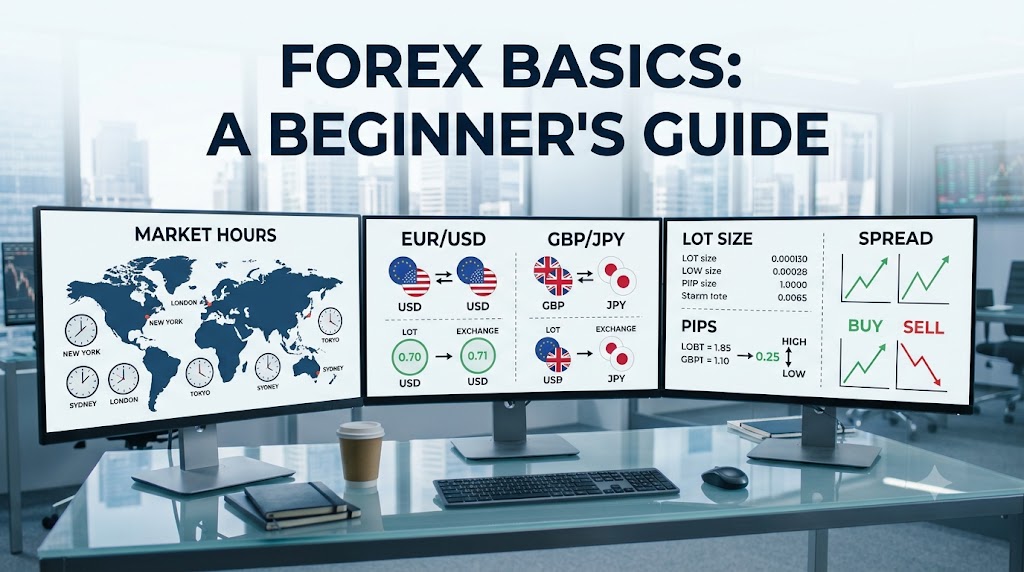
The financial markets can seem like a complex maze to the untrained eye. However, at its core, the global financial system relies on one fundamental activity: the exchange of currencies. This is the domain of the Foreign Exchange Market, universally known as Forex or FX.
If you are asking yourself, “What is Forex Trading?” and how you can navigate this global marketplace, you are in the right place.
Whether you are looking to understand how the global economy moves or aiming to build a structured trading career, this professional guide will lay down the solid foundation you need.
1. What is Forex Trading? (The Core Concept)
At its simplest, Forex trading is the simultaneous buying of one currency and selling of another. Unlike traditional stock markets, where you buy shares of a specific company, in the Forex market, you are essentially buying a “share” in the economy of a particular country.
Did You Know? The Forex market is the largest and most liquid financial market in the world, with a daily trading volume exceeding $7.5 Trillion. This massive liquidity ensures that transactions can be executed instantly with minimal transaction costs.
Unlike the stock market, Forex has no centralized physical exchange (like the New York Stock Exchange). Instead, it operates electronically over-the-counter (OTC) through a global network of banks, financial institutions, brokers, and individual retail traders.
2. Understanding Currency Pairs
In Forex, currencies are always traded in Pairs. You cannot buy USD without selling another currency to acquire it.
Every currency pair consists of a Base Currency (the first currency) and a Quote Currency (the second currency).
$$\text{Base Currency} \ / \ \text{Quote Currency}$$
Take the most heavily traded currency pair in the world as an example: EUR/USD
- EUR (Euro): The Base Currency.
- USD (US Dollar): The Quote Currency.
If the exchange rate of $EUR/USD$ is 1.0950, it means you must pay 1.0950 US Dollars to buy 1 Euro.
- The Long Position (Buying): If you believe the Euro will strengthen against the Dollar, you buy the pair.
- The Short Position (Selling): If you believe the US Dollar will strengthen against the Euro, you sell the pair.
3. Key Participants: Who Moves the Market?
To trade like a professional, you must understand who you are competing against in the market. The Forex market is driven by a diverse group of participants:
- Central Banks & Governments: Institutions like the Federal Reserve (Fed) or the European Central Bank (ECB) influence the market heavily through interest rates and monetary policy.
- Commercial Banks (The Interbank Market): Large banks like JPMorgan Chase, Citi, and Deutsche Bank facilitate the majority of global currency transactions.
- Multinational Corporations: Companies like Apple or Toyota trade currencies to pay for overseas operations and manage import/export costs.
- Retail Traders: Individual traders (like us) who trade through online brokerage platforms. While retail traders represent a small percentage of total volume, they bring vital liquidity to the market.
4. The Anatomy of a Forex Trade (How Profit is Made)
Let’s look at a practical, real-world example of how a professional trader analyzes and executes a trade.
- Your Analysis: You analyze the economic data and notice the Eurozone economy is performing better than expected.
- The Execution: You decide to buy the EUR/USD pair at 1.0800.
- The Market Movement: Over the next few days, the Euro strengthens, and the exchange rate climbs to 1.0950.
- The Result: You close the trade. The difference of 150 pips ($1.0950 – 1.0800$) represents your gross profit, scaled according to your chosen lot size.
5. A Professional Perspective: Risk Over Return
The internet is flooded with “get-rich-quick” schemes claiming Forex is an easy path to wealth. However, as an experienced market participant, my most valuable advice to you is this:
Professional trading is not about predicting the future; it is about managing risk.
Successful trading relies on a proven mathematical edge combined with strict psychological discipline. Before you place your first trade, you must learn the mathematics of risk management, leverage, and capital preservation.
In our upcoming guides, we will break down these essential concepts, including Pips, Leverage, and Lot Sizes, so you can approach the markets with the precision of an institutional fund manager.
Now that you know what is forex trading, always focus on risk management. Understanding what is forex trading is just the first step; consistency comes from discipline.